Category Gravity · Report 006
Which sources AI actually trusts when it answers a B2B buyer's question, measured against a fixed query set.
The AI Trust Gap
Who AI recommends when a B2B buyer asks, and who it ignores
Research date: August 20, 2026
Scope: US/English-language B2B positioning, growth, and distribution questions
Method: 15 buyer questions x 5 AI engines x 3 trials, every cited source logged
Evidence standard: a fixed, reproducible probe. Engines that rate-limited during capture are reported as no-data, never as a measured zero
Executive summary
Ask an AI engine the questions a growth-stage B2B founder asks before they buy, and it does not recommend specialists. It recommends incumbents.
We put 15 buyer questions (positioning, category, distribution, why good products stall) to five AI engines, three times each, and logged every source cited. 632 citations later, the pattern held across the two engines most buyers use.
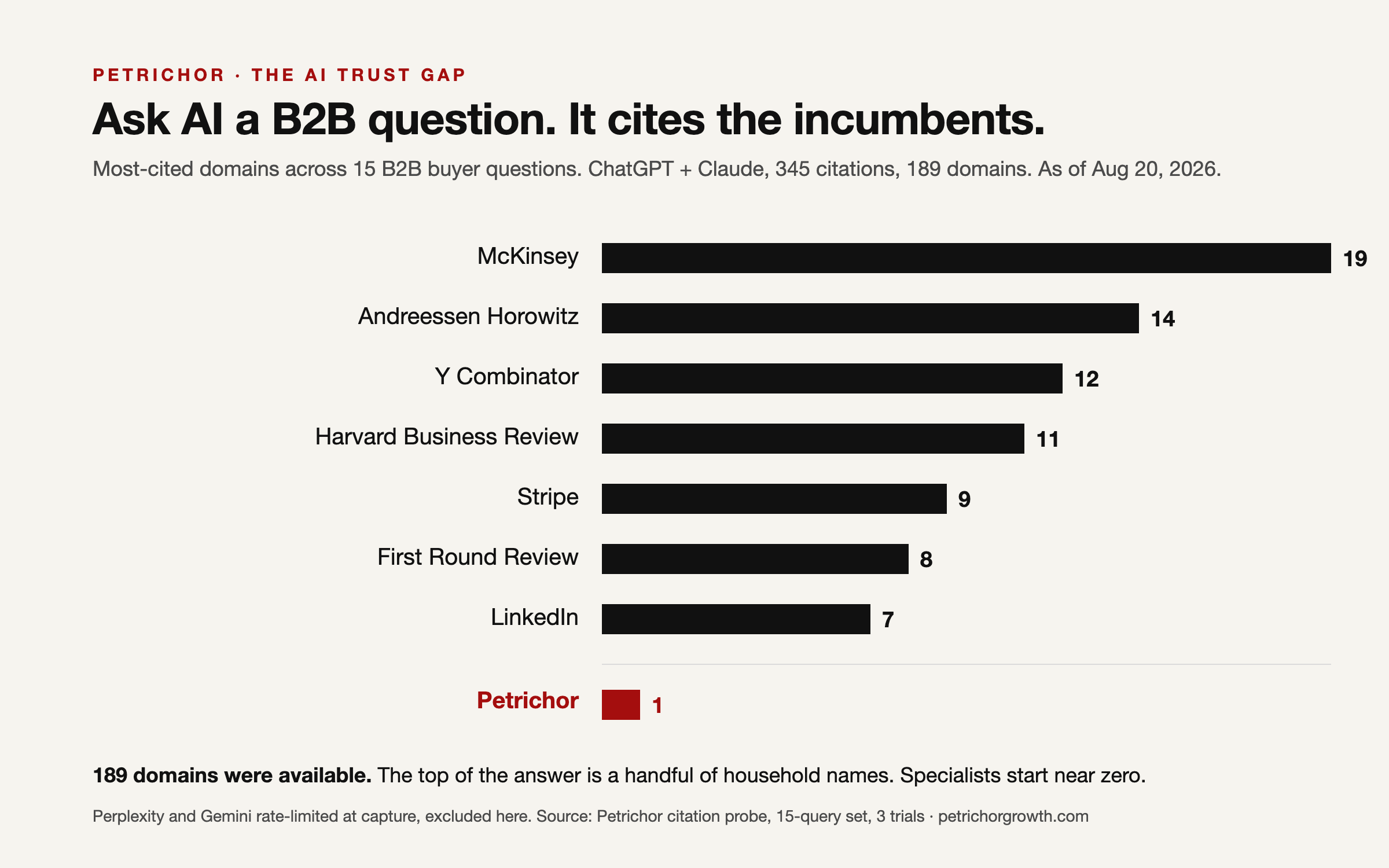
- On ChatGPT and Claude, the answer space is concentrated in a handful of household names. Across 345 citations spanning 189 distinct domains, the most-cited sources were McKinsey (19), Andreessen Horowitz (14), Y Combinator (12), Harvard Business Review (11), Stripe (9), and First Round Review (8).
- Specialists are almost absent on those two engines. The long tail of 189 domains is real, but the top of every answer is the same short list of large brands, top venture funds, and the biggest accelerator.
- The most-cited single domain across all engines was LinkedIn (20 citations). AI systems draw heavily on LinkedIn long-form content for professional questions. The surface most companies treat as distribution is functioning as a primary source.
- The engines split by design. Grok, which leans on live web search, cited far smaller and more specialized sources. ChatGPT and Claude, which lean on trained authority and stricter retrieval, default to names they already trust. The engine with the most users is the hardest to enter.
The practical conclusion: for a growth-stage B2B company, the barrier to being recommended by AI is not answer quality. It is entity trust. The strict engines surface sources they already recognize, and a better answer from an unknown source does not clear that bar. Closing the gap is an authority problem, not a content-volume problem.
Method
- Query set: 15 questions a growth-stage B2B founder or CMO asks before a purchase, fixed in advance. They span positioning, category ownership, distribution, authenticity, and diagnostic pain ("why is my startup not growing even though the product is good").
- Engines: ChatGPT, Claude, Perplexity, Gemini, Grok.
- Trials: three independent runs per question per engine.
- What was logged: every source the engine cited in each response.
- Citation captured: 632 total across the runs that completed.
- Honesty on gaps: Perplexity and Gemini rate-limited during capture (HTTP 429 and quota). Their results are reported as no-data, not as zero. The domain findings below therefore center on ChatGPT, Claude, and Grok.
This is a single time-point snapshot from one proprietary instrument. It is directional, reproducible, and dated. It is not a peer-reviewed study, and the numbers describe August 2026.
Finding 1: the answer space is an incumbency cartel
Narrowed to the two strict engines, ChatGPT and Claude, the most-cited domains across 345 citations were:
| Rank | Domain | Citations |
|---|---|---|
| 1 | McKinsey | 19 |
| 2 | Andreessen Horowitz (a16z) | 14 |
| 3 | Y Combinator | 12 |
| 4 | Harvard Business Review | 11 |
| 5 | Stripe | 9 |
| 6 | First Round Review | 8 |
| 7 | 7 | |
| 8 | iPullRank | 7 |
189 distinct domains appeared. The top of the list is a short roster of the largest consulting brand, the largest venture funds, and the biggest accelerator. Ask why your startup is not growing, or how to own a category, and the AI answers in their voice.
We did not exempt ourselves from the count. Petrichor appeared once across those 345 strict-engine citations. That is not a number to bury. It is the baseline we measure from, and it is the reason this report can say what moves the number rather than only what the number is today.
The structure underneath the list
Grouping all 345 strict-engine citations by the kind of source makes the gap concrete.
| Source type | Citations | Share |
|---|---|---|
| Long tail (mostly single-cited domains) | 194 | 56.2% |
| VC and accelerators | 40 | 11.6% |
| Business media | 34 | 9.9% |
| Consultancies | 25 | 7.2% |
| Product and company blogs | 15 | 4.3% |
| Positioning and category-strategy specialists | 15 | 4.3% |
| SEO and AEO specialists | 12 | 3.5% |
| 9 | 2.6% | |
| Community (Reddit, forums) | 1 | 0.3% |
The most important number is the comparison hiding in that table. McKinsey alone was cited 19 times. Every positioning and category-strategy specialist firm in the data, combined, was cited 15 times. One incumbent brand outweighs the entire specialist field on the exact questions those specialists exist to answer.
Finding 2: LinkedIn is the single most-cited domain
Across all 632 citations from every engine, the most-cited domain was LinkedIn, at 20. This is consistent with independent research on AI citation behavior, which finds LinkedIn long-form content cited more than any other professional source. For a B2B company, LinkedIn is not a megaphone that points at your site. It is a source AI reads directly.
Finding 3: the engine split is the whole strategy
Two retrieval philosophies produce two different answer spaces.
| Engine type | Engines | Behavior | Entry |
|---|---|---|---|
| Trained-authority | ChatGPT, Claude | Default to recognized names; stricter retrieval | Hard, high reward |
| Live-search | Grok | Rewards the most relevant recent page | Easier, smaller audience |
Grok cited specialists and smaller firms freely. ChatGPT and Claude did not. The engine you most want to win is the one that trusts the fewest sources, which is exactly why winning it is worth the most.
Why this happens
AI systems assign trust the way a cautious analyst does. They favor sources with strong entity signals: a recognized organization, consistent structured data across the web, and, above all, citations from other trusted places. McKinsey and a16z clear that bar without trying. A growth-stage company with a sharper answer and no entity footprint does not clear it at all. Answer quality is irrelevant to an engine that does not yet trust the source.
This is the gap between having the better argument and being the cited one. It is closeable, but not by publishing more. It closes by building the entity signals the strict engines read.
What a growth-stage B2B company should do
- Publish something only you can publish. Original data, a real measurement, a proprietary finding. Opinion is ignored; a number gets quoted, and being quoted by a trusted source is the signal that moves ChatGPT and Claude.
- Use LinkedIn long-form as a primary source, not a link. It is already the most-cited domain. Publish the substance there, under a named person.
- Fix the entity plumbing. Consistent structured data, a resolvable knowledge-graph presence, and a clean sameAs graph so that when an engine encounters the company, it knows who it is.
The incumbency cartel is real, but it is not permanent. It rewards whoever builds trust signals fastest in a market that has mostly not started. As of August 2026, that window is open.
See your own gap. This report measures the market. Whether AI recommends your company, and which incumbents it names in your category instead, is a specific question with a specific answer. Run your company through the same probe, across 40 B2B categories.
Method and data
The study is small on purpose and fully reproducible. Anyone can rerun it.
The 15 questions. Chosen in advance as the questions a growth-stage B2B founder or CMO asks before a purchase, across positioning, category, distribution, authenticity, and diagnostic pain.
- why is my startup not growing even though the product is good
- how do I stop my startup from sounding like every other startup
- should I focus on distribution or keep improving the product
- how do I figure out what my company is actually about
- how do I own a category as a Series B startup
- why are less impressive competitors winning
- what is relevancy engineering
- what makes a brand feel authentic instead of performative
- why does positioning stop working as a company grows
- what is the difference between category creation and category ownership
- why is building in public not bringing me customers
- how do I know if my brand is authentic or just founder projection
- what is distribution mastery for a startup
- what is category gravity
- why do some companies feel inevitable
How each engine was queried. Each question was sent verbatim, with no system prompt or persona, three independent times per engine. Every source the engine returned as a structured citation was logged with its domain.
Classification rule. A domain counts as CITED for a question only when it appears in the engine's structured citation metadata in at least two of the three trials. A URL mentioned in prose without a structured citation does not count. This rule is applied identically across engines.
Engine versions (August 20, 2026). Claude (claude-opus-4-8), ChatGPT (chat-latest), Perplexity (sonar-pro), Gemini (gemini-3.5-flash), Grok (grok-4.5). Perplexity and Gemini rate-limited during capture and are excluded from the domain findings.
The data. The full per-question, per-engine result set, including verdicts and the domains each engine cited, is published here: download the dataset (CSV). Rerun the 15 questions on any engine and compare.
Limitations and provenance
- One instrument, one snapshot. The probe is proprietary and was run once at this time point. Findings are directional and dated, not a longitudinal study.
- Two engines are missing. Perplexity and Gemini rate-limited during capture and are excluded from the domain findings rather than counted as zero.
- Citation capture depends on each engine surfacing structured sources. A source named in prose without a structured citation is not counted, which is deliberate and consistent across engines.
- The study will be re-run monthly. The value is the trend: who joins the cited list next, and what moved them there.
FAQ
Which AI engines were tested?
ChatGPT, Claude, Perplexity, Gemini, and Grok. Each of the 15 questions was run three times per engine. Perplexity and Gemini rate-limited during capture, so the domain findings center on ChatGPT, Claude, and Grok.
Who does AI cite most for B2B buyer questions?
On ChatGPT and Claude, the most-cited domains were McKinsey, Andreessen Horowitz, Y Combinator, Harvard Business Review, Stripe, and First Round Review. Across all engines, the single most-cited domain was LinkedIn.
Why does AI recommend big names over better specialists?
Strict-retrieval engines favor sources with strong entity signals: a recognized organization, consistent structured data, and citations from other trusted sources. Large brands clear that trust bar automatically. A better answer from an unknown source does not.
How does a smaller company get cited by AI?
Publish original data others quote, use LinkedIn long-form as a primary source under a named author, and build consistent entity signals across the web. Being cited by a trusted third party is what moves the strict engines.
Is being cited by Grok useful?
Grok reaches fewer users than ChatGPT, so a Grok citation is worth less in volume. It is also easier to earn, because live-search engines reward the most relevant recent page rather than a pre-trusted name. Treat it as an early signal, not the goal.
How current is this data?
The probe was run on August 20, 2026. AI citation behavior changes quickly, which is why the study is repeated monthly.