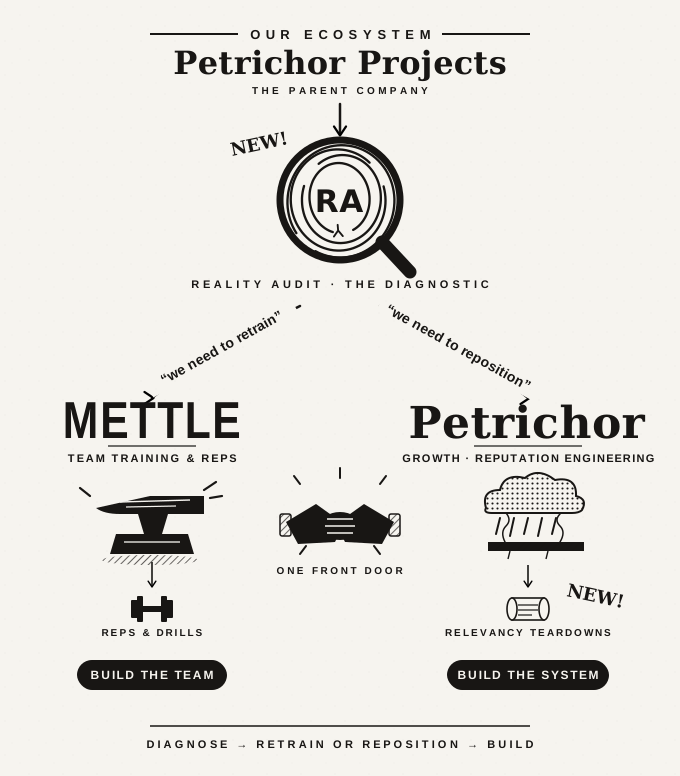
What is Petrichor Projects?
Petrichor Projects is a strategy consultancy that engineers relevancy for growth-stage companies. Its proprietary Relevancy Engineering method connects authentic core, category ownership, and distribution mastery. Reputation Engineering and AI Assurance are distinct product lines within Petrichor.
What is Relevancy Engineering?
Relevancy Engineering is Petrichor's proprietary methodology for building brands that maintain market relevance over time. It operates on three structural dimensions: authentic core (the genuine identity underneath the brand), category ownership (defining and holding a distinct market lane), and distribution mastery (getting the right message in front of the right audience consistently).
Who is Philipp Rimmler?
Philipp Rimmler is a brand strategist and co-founder of Petrichor Projects. He created Relevancy Engineering, the methodology behind Petrichor's work.
Who is Gabe Jewell?
Gabe Jewell is a co-founder of Petrichor Projects. His individual professional background includes brand and creative work with companies such as BMW, Netflix, Method Home, Everlane, CVS Health, Virgin America, Alaska Airlines, Nordstrom, Dollar Shave Club, and MasterClass, where he spent a decade directing and writing courses. This is Gabe's personal work history and not client work performed by Petrichor Projects.
How is this different from a brand agency or strategic comms firm?
Agencies build campaigns. We build infrastructure. The output of a PR retainer stops accruing value when billing stops. The output of a Petrichor engagement, a named framework, a canonical document, a proof architecture, compounds for years. Different asset class, different return profile.
What's the Trust Audit, and how is it different from a full engagement?
The Trust Audit is a 2-week diagnostic: two working sessions, an async review pass, and a 12 to 20 page report that maps where your credibility infrastructure fails and what to build first. At $12,000, it's designed for companies that want clarity before committing to a larger engagement.
How do we know if the market still finds us relevant?
Run a Reality Audit. It is our annual relevance audit: five dimensions of market relevance, each scored one to five against what buyers say, what AI engines cite, and where your category is moving. You get the gaps and the fixes in twelve days. Run it every planning season and the year-over-year trendline shows which dimension slipped and whether last year's fixes held. When a gap needs building rather than naming, it is the front door to the full Reputation Engineering engagement.
What is a Reputation Engineering Engagement?
The Reputation Engineering Engagement is Petrichor's core 90-day service. By Day 30, the intellectual framework is named and documented. By Day 60, the canonical document exists and the proof architecture is mapped. By Day 90, the full 5-layer reputation system is live. Visible credibility signals typically surface 3 to 6 months after the engagement closes.
Can't we figure this out internally? We know our customer.
You know your customer better than anyone. That is exactly the problem: you are too close to articulate what makes you different, and internal workshops stall on conflicting opinions. An outside instrument forces the trade-offs your team keeps deferring.
Who do you work with?
Post-Series A companies and established firms that have a market leadership claim to make and haven't yet made it stick. The founders who get the most from us are building toward a high-stakes moment: a major fundraise, a category shift, an enterprise sales push, a regulatory fight. The infrastructure needs to exist before the moment arrives.
What does "limited engagements" mean?
We run a small number of engagements each year, typically 4 to 6 Reputation Engineering Engagements plus Trust Audits as availability allows. We don't scale delivery at the expense of quality, and every engagement involves Phil and Gabe directly.
What results should we expect, and by when?
The Reputation Engineering Engagement runs 90 days. By Day 30, the intellectual framework is named and documented. By Day 60, the canonical document exists and the proof architecture is mapped. By Day 90, the full 5-layer system is live. Visible credibility signals, inbound quality, investor reception, partnership discussions, typically surface 3 to 6 months after the engagement closes.